with Keith Raphael & Oliver Armfelt
“If you can always see where things are, you can move money faster. Trust works both ways in this space and especially for a relatively young company. Being able to bet on the ledger is huge.”
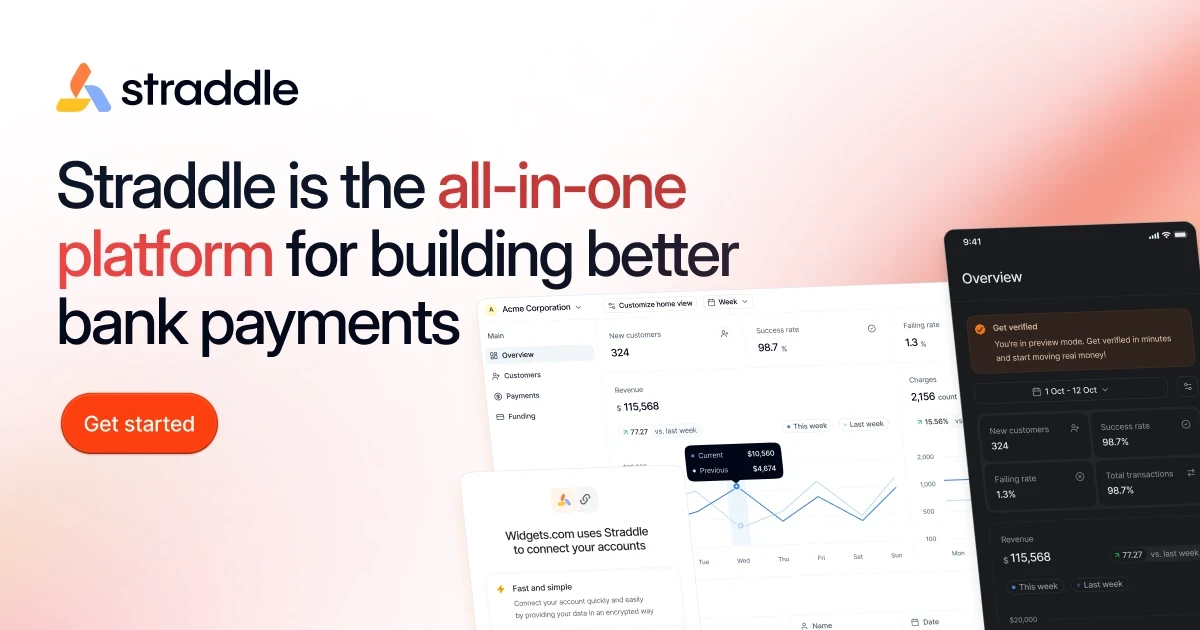
Straddle is building payments infrastructure for the United States to replace legacy payment methods, and everything that makes then painful, but if you ask co-founder Keith Raphael why they exist in one word, it’s visibility.
“Don’t you think it’s strange you can track a pizza to the minute on Doordash, but can’t track payments over a weekend or holiday?” Keith asked Greg Myers in a recent interview.
If you don’t know whether a payment has settled, you can’t release goods, trigger payouts, or reconcile balances without risk. If you know where every dollar is, even in transit, you can act. Money keeps moving.
That’s what Straddle set out to solve, with a deterministic system of record, where state is recorded in real-time, not inferred.
Account to Account Payments in the United States
While the quest for real-time payments drives cross-continental counterparts into the future of transaction processing (UPI in India, Pix in Brazil, Faster Payments in the UK), ACH takes days to get funds from A to B, without strong guarantees about where funds are in-flight, or whether they might be reversed after settlement.
Returns, delayed settlement windows, and asynchronous state transitions mean the system’s ‘truth’ is fragmented across multiple sources. Without any central bank mandate for the adoption of instant payments, there’s an uphill battle for modern payment companies.
Speed aside, simply making payments work is anything but easy: businesses must build a stack that combines identity, compliance (KYC, KYB, AML, and anti-terrorist financing), risk, banking integrations, etc. Each block in the stack has its quirks and edge cases, making for fragile flows and leaking abstractions to the end user who just wants to know, “Where are my funds?”.
Keith knew this all too well from his “accidental” 15-year career in payments. Starting out aged 25 and working in compliance, he went on to become an accredited ACH professional, worked for a large public bank, and was then part of a startup doing unstructured data modeling, where he built deep experience in the challenges of operating a reliable, compliant payments system.
In 2023, a unique opportunity presented itself when his friend, Chad Willard, who’d acquired a legacy ACH processor in 2020, invited Keith aboard to help him turn it around. It was time to be a part of the change.
“I’d spent hours speaking to so many people about compliance and fraud challenges. Following the old venture capital cliche, you should fall in love with the solution, not the problem, but I hated the problem! There just weren’t good answers to fundamental problems for account-to-account money movement. So, we decided we’d do it ourselves.”
So began Straddle, evolving from an existing payments business and stack that was upgraded over eight months to replace legacy technologies and eliminate dependencies, with a vision to do more than just process payments.
Introducing Straddle
Straddle is a financial API infrastructure that brings the trust of card networks to account-to-account payments. According to Keith, the critical piece is trust:
“Money moves at the speed of trust, but in the account-to-account space, there isn’t that intrinsic identity layer that the card networks solved long ago. Business owners have to get their heads around so much: KYC, identity fraud, how open banking works… By building a unified architecture, we provide a compliant-by-default stack they can rely on, so in turn they can focus on building product experiences.”
The team got to work, building an opinionated stack that abstracted both the complexity of integrating with banks, and the half dozen integrations required on top.
“Visibility enables velocity. If you can always see where things are—if you know this is really your customer, or this business is selling, these are good products—you can move money faster.
That trickles all the way down, ultimately to the actual storage and transfer of money into a financial ledger. Which is why we were so excited when we discovered TigerBeetle,” says Keith.
OLTP is Where the Complexity Hides
After they raised their seed round in 2024, knowing the tech upgrade would be a significant endeavor, the Straddle team did extensive market research and product discovery.
Their legacy system relied on banking partners’ APIs for their financial source of truth. For the future that Straddle wanted to build, they needed to own more of the stack, which meant bringing the financial system of record in-house. Relying on external APIs as a source of truth meant accepting eventual consistency in a system that requires strict correctness. That tradeoff no longer made sense.
One of the critical decisions was to own the ledger—but not build it from scratch.
Oliver Armfelt joined Straddle as a founding engineer after years in banking and payments, including re-platforming a UK Bank's CHAPS integration. “The ledgers I’ve seen in some of the banks that are homespun were less than ideal, and that complexity then pervades everything else,” Oliver shares.
It came down to specialization. Straddle didn’t want a SaaS-style-ledger with all the bells and whistles, but an OLTP database with explicit guarantees: strict serializability, atomicity, and no lost writes. Keith's take:
“If I'm relying on AWS not going down, what good is the ledger? We went back to first principles: what was the most purpose-built tool for the job? It was a confluence of years of thinking and then months of research. We hadn't ever considered a double-entry accounting database, so discovering TigerBeetle really got the minds flowing.”
From his vantage point, there is a dichotomy when companies choose ledger technology:
“Fintech startups often just go and build on Stripe, or put some money into Modern Treasury, or use an API because it's 'the done thing. I don't think that holds any water. On the other hand, it can be easy to be overconfident and think you’ve been in the business for so long that you may as well build your own. I'm sure we've all read the stories of Uber and Shopify rolling their own double-entry accounting ledgers. Seeing the good and bad in the space sharpened our aperture for the right solution.”
TigerBeetle is a database specialized for OLTP. It’s not a payments API or ledger SaaS platform. It exposes a minimal, purpose-built data model—debits and credits—designed to enforce correctness at the data layer with all the expressiveness of double-entry accounting. In a post-microservices world, where architects are looking for the holy grail of general purpose databases, Straddle opted for specialization and composability. Each database in their stack serves a distinct purpose (CosmosDB for event sourcing, TigerBeetle for OLTP, MySQL for OLGP).
“I think you should always design with that in mind, that you tune databases to the need, rather than relying on a single general-purpose database that becomes a constraint,” says Oliver.
From first discussions with TigerBeetle to contract signature took a week.
Integrating TigerBeetle was straightforward; the real challenge was designing how money should move. Straddle chose to work with TigerBeetle’s engineers to ensure their design of chart of accounts and transaction flows was optimal.
Designing and Operating TigerBeetle for Safety and Scale
As with many engineers encountering double-entry accounting for the first time, the challenges weren't so technical as they were conceptual. Oliver explains:
“It’s very easy for the two to get mixed. Real money moves between two bank accounts, yet we’ve got six, seven steps through the chart of accounts in terms of where funds are at, and who owes what.
Payments sound simple on paper: accept an instruction, send it to the bank, update a balance. But in practice, every payment path is full of retries, sequencing constraints, conditional flows, and edge cases. There are far more “if, but, maybe” decisions than most people realize.”
The TigerBeetle team helped Straddle translate their flows of funds into a double-entry chart of accounts. The “aha” moment, when the value became clear, was when the team saw money moving through the chart with test payments.
Straddle’s architecture aligned out of the box with TigerBeetle. Event sourcing, idempotency, and transactional guarantees aligned cleanly—allowing them to build business logic without compensating for database anomalies.
Many systems claim transactional guarantees, but still allow anomalies under failure or load (lost writes, weak isolation, or eventual consistency). TigerBeetle guarantees strict serializability, and ensures writes are never lost, a guarantee that propagates up through the rest of the architecture.
“Had we not used TigerBeetle, we would've been making assumptions around some of the steps of the money. Now, we are confident in that lifecycle of money movement. There's no fuzziness. We know we can count on it, and then bring that abstract, arcane knowledge to our customers in an easily digestible format. Because folks really do care about where their money is.”
During migration, they verified that every transaction produced identical ledger state across both systems, using canary payments over a month to verify correctness before switching fully in January 2026. Oliver notes that ideally, the migration would have happened slowly, one account at a time; their timeline was compressed due to bank dependencies and external deadlines.
“We didn’t just adopt the database—we trusted the team operating it,” says Oliver.
When Money is Involved, Trust is Critical
For Straddle, trust goes in both directions, not just to their customers, but also to their banking partners.
“If you have one situation where something was fudged or fuzzy, trust breaks. In a highly competitive market with some of the most well-funded, amazing companies, you don't get too many chances to mess up," Keith explains.
"When we were coming to market, before we even started building our product, there had been significant credit issues here in the US, which led to a series of regulatory consent orders to most of the FinTech focused sponsor banks in the United States. A lot of banks had to leave the space. We went to a publicly traded, top 25 bank in the US and asked them to trust us, and they did. But that trust is only as long as you can keep it.”
Now, when sharing reporting with their bank partners, Keith and the team are excited to show the reliability that they can guarantee with TigerBeetle in FBO ("For Benefit Of") or omnibus type accounts:
“Trust works both ways in this space, and especially for a relatively young company. Being able to bet on the ledger is huge.”
The Future of Payments is Fast
The next step for Straddle: building infrastructure to support more complex money movements. With TigerBeetle as the system of record, Straddle will unlock the ability to send out instant payments at scale, and have just signed an agreement to power instant payments for one of their bank partners. As part of that relationship, the bank is sponsoring Straddle to go directly to all the payment rails. Keith concludes:
“The ability to hold money and then connect to any rail is where we think this is going. To us, it doesn't matter whether it’s an account at a bank, or on a blockchain like Ethereum. The flexibility and scalability that TigerBeetle brings is the bedrock of what we’re building.”
Before, the system depended on external sources of truth: bank statements, delayed responses, and inferred state. Now, Straddle owns it: real-time balances, deterministic state, and a financial system of record Keith and team can build on: “We don’t have to think about the ledger as an infrastructure problem. It’s done.”
The future of payments isn’t slow, opaque, and non-deterministic. It’s payments that maintain an exact, deterministic view of funds at all times. In the future, tracking a payment will be more reliable than tracking a pizza, and Straddle is ready and set to be a pioneer in instant payments.

Industry
Payments
Use
Ledger; Wallets
Needs
Correctness; Simplicity; Foundation for Scale
Country
USA
TPS
100+
Timeline
Around 6–8 months end to end for the broader project; roughly one week from first discussions to signed agreement
Benefits
Single Source of Truth; Correctness; Faster Settlement Foundations; Reduced Dependency Risk
